I've found that when you limit yourself to playing just scales and focus on the "supposed right/correct way of playing" you are doing just that; limiting yourself. By training your ear to hear what notes sound good, you are becoming a more diverse player because you can play along with anything, even if it doesn't make musical sense.

Many guitarists don't know where to begin when first attempting to learn how to play guitar, or any other instrument. In this blog, I have compiled many different free lessons and tools on guitar techniques, musical concepts, and music theory that I think may help many musicians to reach a higher level of playing and to approach music in a new and unique way.
Wednesday, February 23, 2011


useful soloing tips, tricks, and tools
Tip No. 1: Microtonal bends
These aren't as complicated as they sound. It simply means that you bend certain notes in a mode/scale slightly out of tune with you finger(s) so that it sounds good. The easiest way to understand this is to hear it, so have a go at the tab underneath this text.
Tab key:-
--4-- = pluck the string shown while fretting the string on the fret numbered
--h6- = hammer-on your finger onto the string on the fret numbered, doesn't require the string to be plucked
--p2- = pull-off you finger from the string shown to sound a note while fretting the string on the fret numbered
-8b9- = luck the string shown while fretting the string on the fret numbered, then bend the string until the note sounded becomes the same as the note sounded on the fret shown to the right of the b. E.g., 8b9 means pluck the string while fretting the string on the 8th fret, then bend the string one semitone/one fret higher in pitch.
-8b9r8- = same a regular bend but allow string to return to regular position on fret numbered; think of b as meaning bend, and r as meaning relax
--t12- = tap on the fret numbered firmly with one of the fingers in your plucking hand
-t9r5- = tap on the fret numbered firmly with one of the fingers in your plucking hand then release your finger from the string either by simply pulling it off or twanging it, but fret the string on the fret numbered to sound that note after the finger tapping the string has been removed
-mb7- = bend the string slightly after plucking the string number shown, but don't bend it so that raises the note in pitch by a fret.
/ = Slide finger(s)up the fretboard to the fret shown
\ = Slide finger(s)down the fretboard to the fret shown
--9v- = use vibrato by wavering the string up and down by bending it to get a sort of wavy sound
E||------------------|------------------||-12-p10---------------------------|
B||------------------|------------------||---------12-p10-/12-12------------|
G||------------------|-mb7--9--mb12--9--||--------------------14b16-mb12--9v|
D||----------5-h7--9-|------------------||----------------------------------|
A||-5h7-mb10---------|------------------||----------------------------------|
E||------------------|------------------||----------------------------------|
This is a typical blues run in minor pentatonic in E. I put in the microtonal bends in the parts that I felt sounded the best, but there are other places for them. Some better than others. You'll notice the the microtonal bends are on the 3rd and 7th notes in the scale if you were using natural minor. They also appear on the 5th note from time to time, but you can bend that note even further. This is how to use that 5th to get a blues flavour in a solo.
E||------------------|------------------||----------------------------------|
B||------------------|------------------||----------------------------------|
G||------------------|------------------||-------7-h9-------7-h9-p7---------|
D||--------7b9r7-5---|--5--7b8r7-/12-14-||-7h8h9------7h8h9---------9p7-----|
A||--7--10---------7-|------------------||-----------------------------10p7-|
E||------------------|------------------||----------------------------------|
You'll probably find that this is much more noticeable than microtonal bends. Whether this is desirable or not is up to you, and you can use either or both. The point is that you can slip both into you solos if you're using the right mode/scale, for example dorian and aolien/natural minor would both be capable of having these tricks added to them. Happier scales will need the notes moving about to the corresponding notes in those scales. E.g., a major scale has a major third so the major third will be slightly bent as opposed to the minor third slightly bend in the minor scale. A major third is one fret higher than a minor third.
Tip No. 2: southern bending
This is simply what I call this technique and it isn't a technical name for it, but it comes up in southern rock like ZZ-top quite a bit.
E||------------------|------------------||----------------------------------|
B||-12------7--------|-8-----10----5----||----------------------------------|
G||-14b16---9b12-----|-10b12-12b14-7b9--||--/mb12---9v----------------------|
D||------------------|------------------||----------------------------------|
A||------------------|------------------||----------------------------------|
E||------------------|------------------||----------------------------------|
This should give you a sort of echoey sound, as the strings being bent to the degree that they are both sounding the same note. This can be done in any mode or scale, but because of the way the strings are tuned, it's much harder to do on any of the other strings in pairs as the notes are further apart on the fretboard. This is good way to break up a solo when you've been using single notes for a while but don't want use a full chord just yet.
Typically featured in blues music, it is also a pretty widespread trick amongst rock guitarists.
Tip 3: Two handed tapping
Made famous by Eddie van Halen and widely mist-understood and overused by guitarists ever since, is has been in use far longer, with Jeff Beck being amongst the earliest tappers. Tapping essentially gets your guitar to leap to notes much higher than one hand alone would be able to accomplish, as well as making solos sound much more outside the box, even though it has now become a clique. The theory behind tapping is that you follow a scale or mode, and literally tap the note you want to hear from the guitar next. This often allows previously inaccessible notes to be exploited, but remember that you have to follow a mode when using it just like regular playing, tapping isn't an excuse for bad theory.
E||------------------|------------------||----------------------------------|
B||------------------|------------------||----------------------------------|
G||------------------|------------------||------------------9-h12-t16r12p9--|
D||------------------|---7-h10-t14r10p7-||--9-h12-t16r12p9------------------|
A||---7-h10-t14r10p7-|------------------||----------------------------------|
E||------------------|------------------||----------------------------------|
Tip 4: The control dials on your guitar
By plucking a note when your volume dial is at zero, then turning it slowly up, you are able to emulate a violin. This is generally what a volume pedal is used for by professionals, but for all of us with less then 17 digits on our pay checks this trick does the job just as well but requires the use of your hand rather than your foot.
Turning the volume up to maximum makes harmonics and all the other notes or your guitar must distinct, and allows all the gain in your amp to be put to use, so rock and metal players will prefer to do this. Turning you volume down gets a more throaty and less sharp sound, sort of Hendrix/Bolin sound or sweet child o mine sort of thing, but generally switching to the rhythm pickup can do this as well. Remember, less volume on the guitar means less gain. Tone is also similar. Turning it up to full is preferable is you want to hear you notes clearly, as turning it down will add a little bit of mud into the sound generally. It depends on what you want from your instrument.
Tip No. 5: ask for help!
ask people what you want to know. I've covered what I think most guitarists will want to know, but if there are any tricks you want me to teach you then let me know. I can't make the perfect lesson for everyone, but you can help me make the best lesson I can for you.
Tip no. 6: Fretboard Mobility
One of the most often repeated mistakes that guitarists can make sometimes happens when they stay in one position on the fretboard too long. You see, each string has different overtones to each note played on it, as the thickness of the strings varies so too does the tone produced. However that is not the main problem being addressed in this tip; it's what happens when you play notes continually over the same group of frets.
It's like choosing your diet. Too much sweet stuff and you'll be sick of it pretty quickly(with no offense to his fans, I'll use Eddie van Halen as an example. Don't get me wrong, 'eruption' was brilliant, but it's been a long silent time since then from him in my opinion), too much blandness and you soon become bored(for example Eric Clapton). The tricky part is finding the right balance. As a guitarist it's important for you not to become stuck in one frame of mind, so looking at guitarists who use a wide variety of techniques is a good starting point(Joe Satriani, Guthrie Govan, Steve Vai, John Petrucci, Paul Gilbert, Steve Morse, and the guitarist's guitarist himself Jeff Beck who plays everything from heavy metal to techno-funk). The whole point of this variation is like choosing a wider pallet of paints to use for a piece of art. You may not use all of them, and you'll almost certainly have some left over at the end of the day, but at least you had all that you needed.
Tab key:-
--4-- = pluck the string shown while fretting the string on the fret numbered
--h6- = hammer-on your finger onto the string on the fret numbered, doesn't require the string to be plucked
--p2- = pull-off you finger from the string shown to sound a note while fretting the string on the fret numbered
-8b9- = luck the string shown while fretting the string on the fret numbered, then bend the string until the note sounded becomes the same as the note sounded on the fret shown to the right of the b. E.g., 8b9 means pluck the string while fretting the string on the 8th fret, then bend the string one semitone/one fret higher in pitch.
-8b9r8- = same a regular bend but allow string to return to regular position on fret numbered; think of b as meaning bend, and r as meaning relax
--t12- = tap on the fret numbered firmly with one of the fingers in your plucking hand
-t9r5- = tap on the fret numbered firmly with one of the fingers in your plucking hand then release your finger from the string either by simply pulling it off or twanging it, but fret the string on the fret numbered to sound that note after the finger tapping the string has been removed
-mb7- = bend the string slightly after plucking the string number shown, but don't bend it so that raises the note in pitch by a fret.
/ = Slide finger(s)up the fretboard to the fret shown
\ = Slide finger(s)down the fretboard to the fret shown
--9v- = use vibrato by wavering the string up and down by bending it to get a sort of wavy sound
E||------------------|------------------||----------------------------------|
B||------------------|------------------||----------------------------------|
G||------------------|---7---9----------||----------------------------------|
D||------------7---9-|----------7/--9v--||---5---h7---p5--------------------|
A||---7---10---------|------------------||----------------/7v---------------|
E||------------------|------------------||----------------------------------|
This is a very basic lick in minor pentatonic in E. It should sound relatively like a solo but still feel like it's missing something. I'm nowhere near a fantastic guitarist so please bear with me if these licks don't suit your playing style
E||------------------|------------------||-12-p10---------------------------|
B||------------------|------------------||---------12-p10-/12-12------------|
G||------------------|-mb7--9--mb12--9--||--------------------14b16-mb12--9v|
D||----------5-h7--9-|------------------||----------------------------------|
A||-5h7-mb10---------|------------------||----------------------------------|
E||------------------|------------------||----------------------------------|
E||--------10-/15-17-|-17b19------------||----------------------------------|
B||-10-/12-----------|-------17-/20-\15-||-p12-\10-h12-p8-------------------|
G||------------------|------------------||----------------9v----------------|
D||------------------|------------------||----------------------------------|
A||------------------|------------------||----------------------------------|
E||------------------|------------------||----------------------------------|
This mini-solo should feel more like a solo as there is more movement along the fretboard. This is kind of what I'm trying to say with this tip. If you want to get the audience's attention with a solo, you need to give them more to be interested in, rather than doing the same thing endlessly. I'm not going to force you to do anything you don't want to though, and all these tips are tips, not rules.
Tip no. 7: Plucking-hand muting
One of the problems I've seen many players have is that they can't figure out how to mute notes successfully so that they can still hear the note but it's slightly muffled; metal players will recognize this as a sort of 'chug' sound.
Look closely at where your hand is muting the strings. If it's too far away from the bridge(where your strings are sort of nailed onto the body. It will look like a metal bar from most guitars near where you're plucking the strings) you will completely silence the note. Keep your hand on the strings and slowly move it back until you hear the sound you're after. his may be slightly harder for guitars with tremolo systems on them.
Tip no. 8: Octave plucking
This is a technique that is scarcely used but is there for those who want to use it. It's a technique that mimics the effect generated by octave pedals by sounding the same note in two different octaves.
E||------------------|------------------||----------------------------------|
B||------------------|------------------||----------------------------------|
G||---9---12--16-----|--14---7---9------||----------------------------------|
D||------------------|------------------||----------------------------------|
A||---7---10--14-----|--12---5---7------||----------------------------------|
E||------------------|------------------||----------------------------------|
This is an example of this technique in a lick. Keep in mind that this will almost certainly require fingerpicking or hybrid picking to be pulled off correctly. It's definitely good practice for people looking into that style of playing. Breaking up the monotony of a solo with this would be how I would use this, as it's hard to work this technique into a riff, usually.
Tip no. 9: Making Chords Into A Solo
This isn't impossible. Find some chords that you think fit pretty well into a solo, and then see where they should go. This is an excellent way of making a solo sound thicker, and if you want an example of how this is used look into Jimi Hendrix playing All along the watchtower. There's a funk guitar bit right in the middle of the solo, but because of where it is it still fits. Blurring the line between rhythm and lead isn't a bad idea, but it strongly enforces the melody of the song.
What this means is that if you're playing something with a strong melody like 'all along the watchtower', it will sound good. However if you're playing something much more riff-based like 'blackened' or 'the thing that should not be' by Metallica, it probably won't work. It's more reluctant to fit into songs with more notes in their riffs as then all the notes in the chords have to be in the scales or modes that you're playing in. It's a tough theory to crack as it's soloing and chords blurred into one, but look for lessons on it and It is a very good trick to have in your pocket.
Written by LeoKisomma
http://www.ultimate-guitar.com/lessons/soloing/tips_for_guitarists_soloing_secrets.html
These aren't as complicated as they sound. It simply means that you bend certain notes in a mode/scale slightly out of tune with you finger(s) so that it sounds good. The easiest way to understand this is to hear it, so have a go at the tab underneath this text.
Tab key:-
--4-- = pluck the string shown while fretting the string on the fret numbered
--h6- = hammer-on your finger onto the string on the fret numbered, doesn't require the string to be plucked
--p2- = pull-off you finger from the string shown to sound a note while fretting the string on the fret numbered
-8b9- = luck the string shown while fretting the string on the fret numbered, then bend the string until the note sounded becomes the same as the note sounded on the fret shown to the right of the b. E.g., 8b9 means pluck the string while fretting the string on the 8th fret, then bend the string one semitone/one fret higher in pitch.
-8b9r8- = same a regular bend but allow string to return to regular position on fret numbered; think of b as meaning bend, and r as meaning relax
--t12- = tap on the fret numbered firmly with one of the fingers in your plucking hand
-t9r5- = tap on the fret numbered firmly with one of the fingers in your plucking hand then release your finger from the string either by simply pulling it off or twanging it, but fret the string on the fret numbered to sound that note after the finger tapping the string has been removed
-mb7- = bend the string slightly after plucking the string number shown, but don't bend it so that raises the note in pitch by a fret.
/ = Slide finger(s)up the fretboard to the fret shown
\ = Slide finger(s)down the fretboard to the fret shown
--9v- = use vibrato by wavering the string up and down by bending it to get a sort of wavy sound
E||------------------|------------------||-12-p10---------------------------|
B||------------------|------------------||---------12-p10-/12-12------------|
G||------------------|-mb7--9--mb12--9--||--------------------14b16-mb12--9v|
D||----------5-h7--9-|------------------||----------------------------------|
A||-5h7-mb10---------|------------------||----------------------------------|
E||------------------|------------------||----------------------------------|
This is a typical blues run in minor pentatonic in E. I put in the microtonal bends in the parts that I felt sounded the best, but there are other places for them. Some better than others. You'll notice the the microtonal bends are on the 3rd and 7th notes in the scale if you were using natural minor. They also appear on the 5th note from time to time, but you can bend that note even further. This is how to use that 5th to get a blues flavour in a solo.
E||------------------|------------------||----------------------------------|
B||------------------|------------------||----------------------------------|
G||------------------|------------------||-------7-h9-------7-h9-p7---------|
D||--------7b9r7-5---|--5--7b8r7-/12-14-||-7h8h9------7h8h9---------9p7-----|
A||--7--10---------7-|------------------||-----------------------------10p7-|
E||------------------|------------------||----------------------------------|
You'll probably find that this is much more noticeable than microtonal bends. Whether this is desirable or not is up to you, and you can use either or both. The point is that you can slip both into you solos if you're using the right mode/scale, for example dorian and aolien/natural minor would both be capable of having these tricks added to them. Happier scales will need the notes moving about to the corresponding notes in those scales. E.g., a major scale has a major third so the major third will be slightly bent as opposed to the minor third slightly bend in the minor scale. A major third is one fret higher than a minor third.
Tip No. 2: southern bending
This is simply what I call this technique and it isn't a technical name for it, but it comes up in southern rock like ZZ-top quite a bit.
E||------------------|------------------||----------------------------------|
B||-12------7--------|-8-----10----5----||----------------------------------|
G||-14b16---9b12-----|-10b12-12b14-7b9--||--/mb12---9v----------------------|
D||------------------|------------------||----------------------------------|
A||------------------|------------------||----------------------------------|
E||------------------|------------------||----------------------------------|
This should give you a sort of echoey sound, as the strings being bent to the degree that they are both sounding the same note. This can be done in any mode or scale, but because of the way the strings are tuned, it's much harder to do on any of the other strings in pairs as the notes are further apart on the fretboard. This is good way to break up a solo when you've been using single notes for a while but don't want use a full chord just yet.
Typically featured in blues music, it is also a pretty widespread trick amongst rock guitarists.
Tip 3: Two handed tapping
Made famous by Eddie van Halen and widely mist-understood and overused by guitarists ever since, is has been in use far longer, with Jeff Beck being amongst the earliest tappers. Tapping essentially gets your guitar to leap to notes much higher than one hand alone would be able to accomplish, as well as making solos sound much more outside the box, even though it has now become a clique. The theory behind tapping is that you follow a scale or mode, and literally tap the note you want to hear from the guitar next. This often allows previously inaccessible notes to be exploited, but remember that you have to follow a mode when using it just like regular playing, tapping isn't an excuse for bad theory.
E||------------------|------------------||----------------------------------|
B||------------------|------------------||----------------------------------|
G||------------------|------------------||------------------9-h12-t16r12p9--|
D||------------------|---7-h10-t14r10p7-||--9-h12-t16r12p9------------------|
A||---7-h10-t14r10p7-|------------------||----------------------------------|
E||------------------|------------------||----------------------------------|
Tip 4: The control dials on your guitar
By plucking a note when your volume dial is at zero, then turning it slowly up, you are able to emulate a violin. This is generally what a volume pedal is used for by professionals, but for all of us with less then 17 digits on our pay checks this trick does the job just as well but requires the use of your hand rather than your foot.
Turning the volume up to maximum makes harmonics and all the other notes or your guitar must distinct, and allows all the gain in your amp to be put to use, so rock and metal players will prefer to do this. Turning you volume down gets a more throaty and less sharp sound, sort of Hendrix/Bolin sound or sweet child o mine sort of thing, but generally switching to the rhythm pickup can do this as well. Remember, less volume on the guitar means less gain. Tone is also similar. Turning it up to full is preferable is you want to hear you notes clearly, as turning it down will add a little bit of mud into the sound generally. It depends on what you want from your instrument.
Tip No. 5: ask for help!
ask people what you want to know. I've covered what I think most guitarists will want to know, but if there are any tricks you want me to teach you then let me know. I can't make the perfect lesson for everyone, but you can help me make the best lesson I can for you.
Tip no. 6: Fretboard Mobility
One of the most often repeated mistakes that guitarists can make sometimes happens when they stay in one position on the fretboard too long. You see, each string has different overtones to each note played on it, as the thickness of the strings varies so too does the tone produced. However that is not the main problem being addressed in this tip; it's what happens when you play notes continually over the same group of frets.
It's like choosing your diet. Too much sweet stuff and you'll be sick of it pretty quickly(with no offense to his fans, I'll use Eddie van Halen as an example. Don't get me wrong, 'eruption' was brilliant, but it's been a long silent time since then from him in my opinion), too much blandness and you soon become bored(for example Eric Clapton). The tricky part is finding the right balance. As a guitarist it's important for you not to become stuck in one frame of mind, so looking at guitarists who use a wide variety of techniques is a good starting point(Joe Satriani, Guthrie Govan, Steve Vai, John Petrucci, Paul Gilbert, Steve Morse, and the guitarist's guitarist himself Jeff Beck who plays everything from heavy metal to techno-funk). The whole point of this variation is like choosing a wider pallet of paints to use for a piece of art. You may not use all of them, and you'll almost certainly have some left over at the end of the day, but at least you had all that you needed.
Tab key:-
--4-- = pluck the string shown while fretting the string on the fret numbered
--h6- = hammer-on your finger onto the string on the fret numbered, doesn't require the string to be plucked
--p2- = pull-off you finger from the string shown to sound a note while fretting the string on the fret numbered
-8b9- = luck the string shown while fretting the string on the fret numbered, then bend the string until the note sounded becomes the same as the note sounded on the fret shown to the right of the b. E.g., 8b9 means pluck the string while fretting the string on the 8th fret, then bend the string one semitone/one fret higher in pitch.
-8b9r8- = same a regular bend but allow string to return to regular position on fret numbered; think of b as meaning bend, and r as meaning relax
--t12- = tap on the fret numbered firmly with one of the fingers in your plucking hand
-t9r5- = tap on the fret numbered firmly with one of the fingers in your plucking hand then release your finger from the string either by simply pulling it off or twanging it, but fret the string on the fret numbered to sound that note after the finger tapping the string has been removed
-mb7- = bend the string slightly after plucking the string number shown, but don't bend it so that raises the note in pitch by a fret.
/ = Slide finger(s)up the fretboard to the fret shown
\ = Slide finger(s)down the fretboard to the fret shown
--9v- = use vibrato by wavering the string up and down by bending it to get a sort of wavy sound
E||------------------|------------------||----------------------------------|
B||------------------|------------------||----------------------------------|
G||------------------|---7---9----------||----------------------------------|
D||------------7---9-|----------7/--9v--||---5---h7---p5--------------------|
A||---7---10---------|------------------||----------------/7v---------------|
E||------------------|------------------||----------------------------------|
This is a very basic lick in minor pentatonic in E. It should sound relatively like a solo but still feel like it's missing something. I'm nowhere near a fantastic guitarist so please bear with me if these licks don't suit your playing style
E||------------------|------------------||-12-p10---------------------------|
B||------------------|------------------||---------12-p10-/12-12------------|
G||------------------|-mb7--9--mb12--9--||--------------------14b16-mb12--9v|
D||----------5-h7--9-|------------------||----------------------------------|
A||-5h7-mb10---------|------------------||----------------------------------|
E||------------------|------------------||----------------------------------|
E||--------10-/15-17-|-17b19------------||----------------------------------|
B||-10-/12-----------|-------17-/20-\15-||-p12-\10-h12-p8-------------------|
G||------------------|------------------||----------------9v----------------|
D||------------------|------------------||----------------------------------|
A||------------------|------------------||----------------------------------|
E||------------------|------------------||----------------------------------|
This mini-solo should feel more like a solo as there is more movement along the fretboard. This is kind of what I'm trying to say with this tip. If you want to get the audience's attention with a solo, you need to give them more to be interested in, rather than doing the same thing endlessly. I'm not going to force you to do anything you don't want to though, and all these tips are tips, not rules.
Tip no. 7: Plucking-hand muting
One of the problems I've seen many players have is that they can't figure out how to mute notes successfully so that they can still hear the note but it's slightly muffled; metal players will recognize this as a sort of 'chug' sound.
Look closely at where your hand is muting the strings. If it's too far away from the bridge(where your strings are sort of nailed onto the body. It will look like a metal bar from most guitars near where you're plucking the strings) you will completely silence the note. Keep your hand on the strings and slowly move it back until you hear the sound you're after. his may be slightly harder for guitars with tremolo systems on them.
Tip no. 8: Octave plucking
This is a technique that is scarcely used but is there for those who want to use it. It's a technique that mimics the effect generated by octave pedals by sounding the same note in two different octaves.
E||------------------|------------------||----------------------------------|
B||------------------|------------------||----------------------------------|
G||---9---12--16-----|--14---7---9------||----------------------------------|
D||------------------|------------------||----------------------------------|
A||---7---10--14-----|--12---5---7------||----------------------------------|
E||------------------|------------------||----------------------------------|
This is an example of this technique in a lick. Keep in mind that this will almost certainly require fingerpicking or hybrid picking to be pulled off correctly. It's definitely good practice for people looking into that style of playing. Breaking up the monotony of a solo with this would be how I would use this, as it's hard to work this technique into a riff, usually.
Tip no. 9: Making Chords Into A Solo
This isn't impossible. Find some chords that you think fit pretty well into a solo, and then see where they should go. This is an excellent way of making a solo sound thicker, and if you want an example of how this is used look into Jimi Hendrix playing All along the watchtower. There's a funk guitar bit right in the middle of the solo, but because of where it is it still fits. Blurring the line between rhythm and lead isn't a bad idea, but it strongly enforces the melody of the song.
What this means is that if you're playing something with a strong melody like 'all along the watchtower', it will sound good. However if you're playing something much more riff-based like 'blackened' or 'the thing that should not be' by Metallica, it probably won't work. It's more reluctant to fit into songs with more notes in their riffs as then all the notes in the chords have to be in the scales or modes that you're playing in. It's a tough theory to crack as it's soloing and chords blurred into one, but look for lessons on it and It is a very good trick to have in your pocket.
Written by LeoKisomma
http://www.ultimate-guitar.com/lessons/soloing/tips_for_guitarists_soloing_secrets.html
Tuesday, February 22, 2011
Common Music Related Vocabulary
scale - A group of notes that work well together
chromatics - These are basically all twelve (12) notes in an octave. The naturals (7) and non-naturals (5) together make up the chromatics. (7+5=12).
naturals - The notes that do not have sharp or flat names (A, B, C, D, E, F, G). There are seven (7) of them.
non-naturals - The notes that do have the sharps or flats in their names (A#, C#, D#, F#, G#). There are five (5) of them. These notes are also often called the "accidentals".
octave - In traditional music there are only 12 different notes, then they repeat themselves. When you move up or down 12 notes, you will find a higher or lower version of the note you started on. This is an octave. Same note, but one octave higher or lower.
sharps - Sharp generally just means higher. Sharp of the note you are on would be one note higher. To tune sharp you would tune "up".
flats - Flat generally just means lower. Flat of the note you are on would be one note lower. To tune flat you would tune "down".
major - This is a type of scale or chord that sounds bright, happier, and more upbeat. It has no flats in it. This is kind of subjective, and will be explained much more in-depth in the lessons.
minor - This is a type of scale or chord that sounds darker, maybe more sad, kinda gloomy. Minor scales or chords do use flats. This is kind of subjective, and will be explained much more in-depth in the lessons.
root-note - This is basically the same thing as "key". The root note is the note that the music is centered on or built from. You could say its the "main note" in a song.
transpose - Transposing to another key or root simply means to move our scale, etc to another key or root note. It will be the same scale, etc. but now centered on a different key.
position - This would be the four frets that your hand is over at any given time. You have four fingers, one for each fret. Position also refers to the pattern of notes you would play at any four frets for your chosen scale, etc.
fret - Technically, the frets are the small metal bars across the neck of your guitar or bass. When you press your fingertip down between two "frets" you will fret the string and make the appropriate corresponding note. (you do not actually press your fingertip down "on" the frets, but between them)
interval - This is the space between notes. (see whole-step and half-step)
half-step - This is the shortest interval. It is the next note up or down from where you are. For guitar and bass players, this would simply be moving up or down one fret.
whole-step - This is a longer interval than the half-step. With a whole-step you would skip a note and play the second one. For guitar and bass players you would simply "skip a fret" up or down.
pentatonic - This is a type of scale using five different notes. Penta means five and tonic means tone. So a pentatonic scale is a "five tone scale".
mode - If theory is learned properly, the meaning of this would be different, but this term generally applies to a group of seven note scales.
melodic-interval - A single note.
harmonic-interval - Two notes at a time.
chordal-interval - Three or more notes at a time.
barre - The use of your index finger to hold down more than one string at one fret in a single chord, in order to build chords with that fret as the "nut".
barre chord - A guitar chord in which your index finger barres all strings at one fret, and the rest of the chord is built using that fret as the nut. For example, in an F# chord, the index finger barres the second fret, and the other three fingers make an E chord using the second fret as the nut.
bass note - The lowest note played in a chord, shown either by the chord name (e.g. E in E) or the note listed after a slash (e.g. F# in G/F#).
chord - Three or more pitches played simultaneously, usually a root, third, and fifth, though sometimes a seventh is added.
circle of fifths - A musical tool showing the relatedness of keys.
closely related keys - The fifth up and fifth down (fourth up) from any key. For example, the keys closely related to G are C (fifth down) and D (fifth up).
diminished fifth - An interval made up of two whole steps and two half steps. For example, the distance between D and Ab is a diminished fifth.
diminished chord - A chord consisting of a minor third and a diminished fifth. For example, a D diminished chord (D?) contains D, F, and Ab.
dominant - The fifth note of the major scale. The major chord built on the dominant, designated V, leads strongly toward the tonic.
fifth - In a scale, the distance between a certain note and another note four notes above it. The certain note is counted as I, the note four notes above that is V.
half step - The smallest recognized interval in Western music. The distance represented by one fret on a guitar is a half step.
interval - The musical distance between two notes, measured by the number of whole and half steps between the two notes.
inversion - The use of notes in the chord other than the root as the bass note (e.g. F# bass in a D chord).
key - The basis of musical sounds in a piece. Each key uses the notes and chords of the corresponding major scale. The key is named after the tonic (e.g. the tonic in the key of A is A).
leading - The tendency that certain notes and chords have to resolve to other specific notes or chords.
leading tone - The seventh note of the major scale, one half step below the tonic. This note leads strongly toward the tonic.
major chord - A chord consisting of a major third and a perfect fifth. For example, a D major chord (D) contains D, F#, and A.
major scale - A group of eight notes with the following whole step/half step pattern between them: W-W-H-W-W-W-H. For example, the A major scale consists of A, B, C#, D, E, F#, G#, and A.
major seventh - An interval made up of five whole steps and one half step. For example, the distance between D and C# is a major seventh.
major third - An interval made up of two whole steps. For example, the distance between D and F# is a major third.
minor chord - A chord consisting of a minor third and a perfect fifth. For example, a D minor chord (Dm) contains D, F, and A.
minor seventh - An interval made up of four whole steps and two half steps. For example, the distance between D and C is a minor seventh.
minor third - An interval made up of one whole step and one half step. For example, the distance between D and F is a minor third.
modulate - To change keys.
muting - Pressing your finger against a string while playing a chord to avoid playing that string. Muting is represented by an x in my chord diagrams (as in E/G#: 4x2400).
perfect fifth - An interval made up of three whole steps and one half step. For example, the distance between D and A is a perfect fifth.
resolve - A musical progression which brings finality to part of a piece.
root - The note a chord is built on.
seventh - In a scale, the distance between a certain note and another note six notes above it. The certain note is counted as I, the note six notes above that is vii.
seventh chord - A chord consisting of a major third, a perfect fifth, and a minor seventh. For example, a D seventh chord (D7) contains D, F#, A, and C. Major seventh chords (notated maj7) contain a major seventh instead of a minor seventh.
suspended chord - A chord containing either the root, second, and fifth (sus2), or the root, fourth, and fifth (sus4).
third - In a scale, the distance between a certain note and another note two notes above it. The certain note is counted as I, the note two notes above that is iii.
tonic - The note on which the major scale is based. The major chord built on the tonic, designated I, is the eventual goal of any song.
transpose - Moving the musical position of a piece, keeping all intervals as they were in the original piece. For example, if you have C, F, and G (I, IV, and V), and you want to transpose to the key of G, then use the I, IV, and V of G, which are G, C, and D.
http://www.all-guitar-chords.com/guitar_chords_glossary.php
chromatics - These are basically all twelve (12) notes in an octave. The naturals (7) and non-naturals (5) together make up the chromatics. (7+5=12).
naturals - The notes that do not have sharp or flat names (A, B, C, D, E, F, G). There are seven (7) of them.
non-naturals - The notes that do have the sharps or flats in their names (A#, C#, D#, F#, G#). There are five (5) of them. These notes are also often called the "accidentals".
octave - In traditional music there are only 12 different notes, then they repeat themselves. When you move up or down 12 notes, you will find a higher or lower version of the note you started on. This is an octave. Same note, but one octave higher or lower.
sharps - Sharp generally just means higher. Sharp of the note you are on would be one note higher. To tune sharp you would tune "up".
flats - Flat generally just means lower. Flat of the note you are on would be one note lower. To tune flat you would tune "down".
major - This is a type of scale or chord that sounds bright, happier, and more upbeat. It has no flats in it. This is kind of subjective, and will be explained much more in-depth in the lessons.
minor - This is a type of scale or chord that sounds darker, maybe more sad, kinda gloomy. Minor scales or chords do use flats. This is kind of subjective, and will be explained much more in-depth in the lessons.
root-note - This is basically the same thing as "key". The root note is the note that the music is centered on or built from. You could say its the "main note" in a song.
transpose - Transposing to another key or root simply means to move our scale, etc to another key or root note. It will be the same scale, etc. but now centered on a different key.
position - This would be the four frets that your hand is over at any given time. You have four fingers, one for each fret. Position also refers to the pattern of notes you would play at any four frets for your chosen scale, etc.
fret - Technically, the frets are the small metal bars across the neck of your guitar or bass. When you press your fingertip down between two "frets" you will fret the string and make the appropriate corresponding note. (you do not actually press your fingertip down "on" the frets, but between them)
interval - This is the space between notes. (see whole-step and half-step)
half-step - This is the shortest interval. It is the next note up or down from where you are. For guitar and bass players, this would simply be moving up or down one fret.
whole-step - This is a longer interval than the half-step. With a whole-step you would skip a note and play the second one. For guitar and bass players you would simply "skip a fret" up or down.
pentatonic - This is a type of scale using five different notes. Penta means five and tonic means tone. So a pentatonic scale is a "five tone scale".
mode - If theory is learned properly, the meaning of this would be different, but this term generally applies to a group of seven note scales.
melodic-interval - A single note.
harmonic-interval - Two notes at a time.
chordal-interval - Three or more notes at a time.
barre - The use of your index finger to hold down more than one string at one fret in a single chord, in order to build chords with that fret as the "nut".
barre chord - A guitar chord in which your index finger barres all strings at one fret, and the rest of the chord is built using that fret as the nut. For example, in an F# chord, the index finger barres the second fret, and the other three fingers make an E chord using the second fret as the nut.
bass note - The lowest note played in a chord, shown either by the chord name (e.g. E in E) or the note listed after a slash (e.g. F# in G/F#).
chord - Three or more pitches played simultaneously, usually a root, third, and fifth, though sometimes a seventh is added.
circle of fifths - A musical tool showing the relatedness of keys.
closely related keys - The fifth up and fifth down (fourth up) from any key. For example, the keys closely related to G are C (fifth down) and D (fifth up).
diminished fifth - An interval made up of two whole steps and two half steps. For example, the distance between D and Ab is a diminished fifth.
diminished chord - A chord consisting of a minor third and a diminished fifth. For example, a D diminished chord (D?) contains D, F, and Ab.
dominant - The fifth note of the major scale. The major chord built on the dominant, designated V, leads strongly toward the tonic.
fifth - In a scale, the distance between a certain note and another note four notes above it. The certain note is counted as I, the note four notes above that is V.
half step - The smallest recognized interval in Western music. The distance represented by one fret on a guitar is a half step.
interval - The musical distance between two notes, measured by the number of whole and half steps between the two notes.
inversion - The use of notes in the chord other than the root as the bass note (e.g. F# bass in a D chord).
key - The basis of musical sounds in a piece. Each key uses the notes and chords of the corresponding major scale. The key is named after the tonic (e.g. the tonic in the key of A is A).
leading - The tendency that certain notes and chords have to resolve to other specific notes or chords.
leading tone - The seventh note of the major scale, one half step below the tonic. This note leads strongly toward the tonic.
major chord - A chord consisting of a major third and a perfect fifth. For example, a D major chord (D) contains D, F#, and A.
major scale - A group of eight notes with the following whole step/half step pattern between them: W-W-H-W-W-W-H. For example, the A major scale consists of A, B, C#, D, E, F#, G#, and A.
major seventh - An interval made up of five whole steps and one half step. For example, the distance between D and C# is a major seventh.
major third - An interval made up of two whole steps. For example, the distance between D and F# is a major third.
minor chord - A chord consisting of a minor third and a perfect fifth. For example, a D minor chord (Dm) contains D, F, and A.
minor seventh - An interval made up of four whole steps and two half steps. For example, the distance between D and C is a minor seventh.
minor third - An interval made up of one whole step and one half step. For example, the distance between D and F is a minor third.
modulate - To change keys.
muting - Pressing your finger against a string while playing a chord to avoid playing that string. Muting is represented by an x in my chord diagrams (as in E/G#: 4x2400).
perfect fifth - An interval made up of three whole steps and one half step. For example, the distance between D and A is a perfect fifth.
resolve - A musical progression which brings finality to part of a piece.
root - The note a chord is built on.
seventh - In a scale, the distance between a certain note and another note six notes above it. The certain note is counted as I, the note six notes above that is vii.
seventh chord - A chord consisting of a major third, a perfect fifth, and a minor seventh. For example, a D seventh chord (D7) contains D, F#, A, and C. Major seventh chords (notated maj7) contain a major seventh instead of a minor seventh.
suspended chord - A chord containing either the root, second, and fifth (sus2), or the root, fourth, and fifth (sus4).
third - In a scale, the distance between a certain note and another note two notes above it. The certain note is counted as I, the note two notes above that is iii.
tonic - The note on which the major scale is based. The major chord built on the tonic, designated I, is the eventual goal of any song.
transpose - Moving the musical position of a piece, keeping all intervals as they were in the original piece. For example, if you have C, F, and G (I, IV, and V), and you want to transpose to the key of G, then use the I, IV, and V of G, which are G, C, and D.
http://www.all-guitar-chords.com/guitar_chords_glossary.php
Explaining the Guitar Neck and Fretboard For Beginners
Explaining The Guitar Neck Diagrams
For those of you who are not used to reading these types of illustrations or diagrams I thought I would include some explanation on them. I usually draw a standard guitar neck diagram that would appear the same as it would when you look down at your guitar or bass neck. What you will see when looking at the diagram below is the "low E" string (the fattest one) on the bottom, and the "high E" (the thinnest one) on top. This should be easy to tell as the string sizes are visible on the neck. If you have not yet memorized the string names, they are listed right here and now would be an excellent time to do so.
In actual diagrams, you will see dots on the fretboard marking where the notes should be played. They will be in various colors and will mean various things.
Also, if you see note markers that are all the way at the end of the neck, and are not in between frets where you would put your finger, but rather right on the "nut" at the end, these are "open" notes and do not need to be fretted at all.
* note for bass players: Bass players can use the exact same diagrams as the guitar diagrams, using only the bottom four strings (low E, A, D, G). This means that everything is the same for bass, you would just ignore the B and High E strings. (this can change for 5 string basses, etc)
http://www.theorylessons.com/basics002diagrams.php
For those of you who are not used to reading these types of illustrations or diagrams I thought I would include some explanation on them. I usually draw a standard guitar neck diagram that would appear the same as it would when you look down at your guitar or bass neck. What you will see when looking at the diagram below is the "low E" string (the fattest one) on the bottom, and the "high E" (the thinnest one) on top. This should be easy to tell as the string sizes are visible on the neck. If you have not yet memorized the string names, they are listed right here and now would be an excellent time to do so.
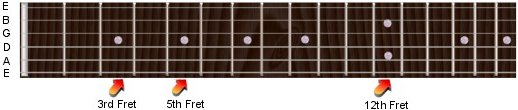 |
| ^ Neck Diagram ^ |
In actual diagrams, you will see dots on the fretboard marking where the notes should be played. They will be in various colors and will mean various things.
Also, if you see note markers that are all the way at the end of the neck, and are not in between frets where you would put your finger, but rather right on the "nut" at the end, these are "open" notes and do not need to be fretted at all.
* note for bass players: Bass players can use the exact same diagrams as the guitar diagrams, using only the bottom four strings (low E, A, D, G). This means that everything is the same for bass, you would just ignore the B and High E strings. (this can change for 5 string basses, etc)
http://www.theorylessons.com/basics002diagrams.php
Melodic Control - how to play a better solo/lead
Soloing can be a very difficult task at first. For me, I found this video extremely helpful in understanding all of the various notes I can hit and how I can string them together to form solos with more distinct melodies in them.
Jimi Hendrix Rhythm Guitar Techniques
Jimi Hendrix was an incredibly innovative guitar player. He utilized techniques such as those demonstrated in this video in order to play new things that not many other guitarists play. He made his style unique and expressed his creative thought process instead of simply playing in a way that others would view as "correct". By putting these techniques into your playing, fluidly playing in various techniques around the fretboard should become more clear.
ROCK ON Jimi \,,,/_
What Are Time Signatures?
For those of you who don't know, a time signature is represented by a fraction. You've probably looked at some sheet music and saw the fraction 4/4 at the beginning of the peice. That is a time signature.
The numerator is pretty easy to understand, but the denominator might get a little confusing. When I say "what type of note gets the beat," I'm talking about note values such as quarter notes, eighth notes, sixteenth notes, and so on. A quarter note will be represented by a 4, a half note will be represented by a 2, a whole note by a 1, an eighth note by an 8, a sixteenth note by a 16, and they usually won't go up any higher than that.
So, that being said, you should be able to understand what is meant by these time signatures.
In the time signature 4/1 you will have four whole notes in a measure.
In the time signature 4/2 you will have four half notes in a measure.
In the time signature 4/4 you will have four quarter notes in a measure.
In the time signature 4/8 you will have four eighth notes in a measure.
In the time signature 4/16 you will have four sixteenth notes in a measure.
Changing the numerator will change the number of whole, half, quarter, eighth, or sixteenth notes that can appear in the measure.
Just to clear up a bit of confusion that I might have just caused, you can use notes other than the ones specified by the time signatures. For example, in a measure of 4/4, you don't have to stick to just quarter notes, you can use eighth notes or half notes or quarter notes. This is where you will have to do a little math. If you wanted to use eighth notes, you can use 8 in a measure of 4/4 because eighth notes are half the value of a quarter note. This can all get very confusing, so here is a chart to help explain.
1 Whole note = 2 Half notes = 4 Quarter notes = 8 eighth notes = 16 sixteenth notes
Maybe it's not a chart, but it is a short tool to help you learn note values. I would go further into detail with it, but this is a lesson on time signatures, not note values.
So, now that you have a basic understanding of time signatures, it's time to learn how to count them. To count a measure of 4/4, you can count like this: 1, 2, 3, 4. Simple. That is what most of today's(and a lot of yesterday's) music sounds like. Listen to any pop song on the radio and you can feel the beat. You can count along with it, 1,2,3,4.
Remember! When you count the time signatures like this, you will accent the 1.
Let's move on to something a little more unusual: 5/4. This is a very simple time signature but can be hard to play at first. You would normally count 5/4 like this: 1, 2, 3, 4, 5. That is the normal way to count it, however, you can count it like this: 1, 2, 1, 2, 3. As long as there are 5 counts of quarter notes in it, you will be fine.
Now we can try a more simple and more "normal" time signature. 3/4 is very popular in waltz music. It is counted: 1, 2, 3. Very simple.
Here's one of my favorite time signatures of all, 7/8. In this time signature, you will be counting eighth notes. There will be seven eighth notes in each measure(or the equivilant of 7 eighth notes). There are several ways to count this so here are a few:
As you can see, when you get to the larger numerators there are several ways to count the time signatures. Keep in mind that just because you're playing in 7/8 that does not mean that 7/8 will always be faster than 7/4, the speed will always be dictated by the tempo.
Time signatures are taught more to percussionists than to guitarists but they can be just as useful to us.
Like most music theory, you must physically practice this on your instrument. So the big question is, "How do I go about practicing time signatures?" It's very simple, you will only use one chord or note, we'll just say you can us the standard E5 power chord
and play the notes in the time signature. Count 1, 2, 3, 4 and play the E5 each time you count, making sure to accent the 1. Make sure that you're consistant with the notes as well, you don't want to play the 1 and hold it longer than the 2, 3, and 4.
written by ironwolg
http://www.ultimate-guitar.com/lessons/the_basics/time_signatures.html
Subscribe to:
Posts (Atom)